


January 26, 2014
— andy For comments 'n' such.
Posted by: andy at
04:29 AM
| Comments (319)
Post contains 12 words, total size 1 kb.
January 25, 2014
— Open Blogger In spite of submarine warfare causing the British and French great distress in World War I, it wasnÂ’t until 1915 that anyone came up with an effective means of attacking a submerged U-boat, the depth charge.
You’ve seen enough movies to have a basic grasp of what a depth charge is. A cylindrical container full of explosives rolled off the back of an escort ship that detonates when it reaches a preset depth, as determined by a hydrostatic firing device (know in the business as a “firing pistol” for some reason).
But simply rolling a few depth charges off the stern of a ship over the likely position of a submarine is very unlikely to yield any real effects on the target. Most depth charges weigh between 300 and 600 pounds. Roughly 1/2 to 2/3 that weight is explosive. And to be effective, a depth charge has to detonate within about 30 to 40 feet of the submarine. Given the extremely poor state of sensors in those days, coming that close would be more a matter of chance than tactics. Indeed, between 1915 and 1917, only 9 U-boats were sunk by depth charge. The linear pattern of depth charges meant a simple turn by the U-Boat could easily remove it from danger. The solution for the escort was to widen area covered by a single attack. Perhaps two ships could make parallel depth charge attacks? But there was seldom enough ships to allow this, nor were two ships likely close enough to be able to quickly coordinate an attack. Instead, the Y-Gun depth charge projector was invented.
The Y-Gun was basically a mortar with a single charge firing into two tubes arranged in a Y-shape. In each of the tubes was a piston that ended in a broad curved “lear” (leading to the pistons being know as arbors) that nestled a depth charge. Mounted on the centerline of a destroyer, when fired, a Y-Gun would send a depth charge about 40-50 yards to both port and starboard of the ship. Even such a modest increase in the square area of a depth charge pattern greatly increased the likelihood of a successful attack.
By the end of World War I, most destroyer types had at least one and and usually two Y-Guns aboard.
By the beginning of World War II, active sonar had improved to the point that, while not terribly effective as an area search weapon, it provided decent bearing and range information for an attacking escort. But ASW planners failed to understand the importance of determining the depth of a target sub. Some estimation could be made. The shape of the sonar beam and the way it angled through the water could provide a very rough trigonometric estimation of depth. The other serious improvement in technology was the rather simple idea of splitting a Y-Gun in half. The K-Gun fired one charge to one side. The advantage of this was that K-Guns could be mounted along the sides of an escort without displacing other weapons from centerline space. Even relatively small escorts could carry four, six, even as many as ten K-Guns. Combined with two chutes of depth charges, a pattern of charges could be laid on the suspected position of the target sub.
The uncertainty of the depth of the target meant that in addition to charges being delivered along the path of the attacking escort, and to the sides via the K-Guns, the attack had to be delivered at varying depths as well. Eventually the standard attack would evolve to be a “10 charge” attack. Essentially, two overlaying diamond shape patterns (with a fifth charge in the center) at two depths, above and below the suspected depth of the sub, to sandwich the target, or catch it as it attempted to turn away.
This double diamond attack was by far the most effective depth charge of the war. It had a whopping 5% success rate of sinking or seriously damaging its target.
One of the most serious shortcomings of the depth charge as an ASW weapon was that the attacking ship would lose contact with the target, depending on its depth, at a range of from 200 yards clear out to as much as 500 yards. Counting the time needed for the ship to travel that distance, and the further delay for the charges to sink, the target sub had significant time to maneuver to escape. And the explosion of the depth charges roiled the water, meaning
Later, weÂ’ll look to weapons and sensors that addressed these shortcomings.
Crossposted at my place.
Posted by: Open Blogger at
10:06 PM
| Comments (66)
Post contains 781 words, total size 5 kb.
January 26, 2014
— Open Blogger For non-book related discussion.
This morning's open thread brought to you by birds of prey: more...
Posted by: Open Blogger at
06:48 AM
| Comments (33)
Post contains 31 words, total size 1 kb.
— Open Blogger

"She'll Pay For This"
Good morning morons and moronettes and welcome to the award-winning AoSHQ's prestigious Sunday Morning Book Thread.
The Unbearable Whiteness of Being
Did you know that the central theme of Mark Twain's The Adventures of Huckleberry Finn is the evil of racism? No? Well, then, you should be thankful that we have Margaret E. Wright-Cleveland of Florida State University to tell us these things. In an article that polls a number of "experts" as to what is the greatest American novel, she proclaims:
A land defined and challenged by racism, America struggles with how to understand and move beyond its history...Twain confronts American history head-on and tells us this: White people are the problem...
If the Great American Novel both perceptively reflects its time and challenges Americans to do better, Huck Finn deserves the title. Rendering trenchant critiques on every manifestation of whiteness, Twain reminds us that solving racism requires whites to change.
Now it's obvious that Margaret E. Wright-Cleveland of Florida State University very much believes this. But I thought it would have been taught in Crit. Lit. 101 not to read your own attitudes and beliefs back into authors who lived in earlier centuries and most likely had different assumptions and modes of thinking due to living in a culture different than ours. Otherwise, objective meaning is lost and books become nothing but Rorschach ink blots upon which you merely project your own prejudices and fears.
The education writer E. D. Hirsh is best known for for his book on cultural literacy, but he is also the author of an earlier work, Validity in Interpretation, which lays out a systematic and detailed defense of the idea that the meaning of the text is determined solely by the intent of the author. It's written more for an academic than for a popular audience, so it can be a bit dry, but if you stick with it, it's quite good.
Now, I'm sure that Margaret E. Wright-Cleveland of Florida State University would no doubt argue that what she said was in fact Twain's intended meaning. But if I were to read a book and conclude that an author who lived many years before me somehow had managed to have beliefs that coincide exactly, 100% with mine, shouldn't that give me pause? Shouldn't I be even the least bit skeptical? Like that silly biography I mentioned a couple of weeks ago that populated Norman Rockwell's paintings with all manner of sexual sub-texts that every viewer and art critic somehow had missed until she came along and pointed them out to us, there's no end to the foolishness you can get into once you sacrifice objective meaning and substitute your own.
The New Republic actually has a pretty good article you can read on a similar theme:
Proust was a neuroscientist. Jane Austen was a game theorist. Dickens was a gastroenterologist. That’s the latest gambit in the brave new world of “consilience,” the idea that we can overcome the split between “the two cultures” by bringing art and science into conceptual unity—which is to say, by setting humanistic thought upon a scientific foundation.That’s the latest gambit in the brave new world of “consilience,” the idea that we can overcome the split between “the two cultures” by bringing art and science into conceptual unity—which is to say, by setting humanistic thought upon a scientific foundation.
Which is kind of like substituting your own meaning for the author's. The TNR piece goes on to a scathing review of Jane Austen, Game Theorist by Michael Suk-Young Chwe, and indirectly, Proust Was a Neuroscientist by Jonah Lehrer.
Posted by: Open Blogger at
06:49 AM
| Comments (215)
Post contains 1230 words, total size 9 kb.
January 25, 2014
— Monty (I apologize for the prolonged hiatus, my groovy and beloved babies. Life doth intervene.)
Articles like this make me wonder if the bien pensant journalist-and-pundit class knows any actual poor people. I was born poor, grew up poor, and spent a good chunk of my 20's poor. Not genteel poor, either -- I mean hard, stony-bottom, empty-pocket poor. I come from poor people.
Poor people don't think about money in the same way that more well-off people do. When you're poor, money -- and the lack thereof -- informs your every moment, waking and sleeping. You know exactly, at any given moment, how much money you have, down to the penny. How much in the bank, how much in your jeans, how much in the coffee can on the counter at home. Every purchase is a choice -- if I buy this six-pack now, that means hot dogs instead of hamburger for dinner tomorrow; if I pay my cable bill, that means that instead of dinner and a movie my best girl and I get to spend a night at home watching the TV. You triage your bills -- rent comes first, then heat. Then...you decide: cable or cellphone? Who can you put off the longest? How long can you float things?
more...
Posted by: Monty at
04:48 PM
| Comments (235)
Post contains 928 words, total size 5 kb.
— Open Blogger Would you?
I so would. And I'd laugh and scream and giggle like a little girl the entire way down.
The slide's drop is so steep, it is almost at a right-angle to the ground. Thrill-seekers will need to climb 264 steps to reach the top where they will wait on a deck made from railroad tanker cars. They will then be sent hurtling down into the pool below.The exact height of the Verruckt has not being revealed but bosses say it will be taller than the current record holder, the 134.5ft Insano slide in Fortaleza, Brazil.
Oh yeah!
So, are you Moron enough?
Posted by: Open Blogger at
02:53 PM
| Comments (302)
Post contains 119 words, total size 1 kb.
— Ace That didn't take very long at all, now did it.
The hive reacts frantically and angrily at signs of a foreign presence.
? I open up the “Saturday Morning Headlines” email and this is at the top. Is the WashPo going gun nut? They hired what looks like a teenage law professor? “Negroes and the Gun”?? What? And what the hell is a Volokh Conspiracy?You go to read NEWS, and you get BIZARRE. That’s the internet for ya. Too bad it’s happening at the Washington Post. Yet another sign of decadence.
Eugene Volokh answers him with far greater bonhomie than I could ever hope to manage.
Volokh tries to reassure him that the new libertarian/conservative leaning blog will be offering Washington Post readers solid facts, novel arguments, and fresh perspectives, some of them quite strong and possibly even quite convincing.
I hate to tell him this but: They know that's what you're offering to the public. That's the problem.
Thanks to @tsrblke.
[Update - Andy:] I was about to double-post the Head Ewok on this. Glad I looked.
But this needs a screenshot. Like I said on Twitter, it's like I died and woke up in schadenheaven.
[Eugene Volokh] Follow just our gun-related posts on Twitter, using @VolokhGuns: IÂ’ve set up a new Twitter fee... http://t.co/l8imlGXR9M
— Volokh Conspiracy (@VolokhGuns) January 25, 2014
Posted by: Ace at
12:19 PM
| Comments (237)
Post contains 259 words, total size 2 kb.
— CDR M

So the President is pushing college education, but is it really required for the jobs that you are most likely to get? Especially in a tanking economy where there is a growth of college grads in dead-end jobs. Is it worth 6 figure debt when you could do this? But if you do go for a degree, perhaps it should be oil and gas related. more...
Posted by: CDR M at
06:15 PM
| Comments (410)
Post contains 387 words, total size 5 kb.
— CAC This is his second week of hosting a show on Connecticut's 1320 WATR. We all wish him the best of luck in his quest to become a media tyrant. You can listen to him every Saturday, from noon to 2pm EST, at the link below.
I'm honored that he chose me to co-host his show today, even if he isn't officially calling me the co-host. We all know how everyone has been scrambling to listen to me, and hang on my every word, well, now you have the opportunity to listen.
To me.
Lots of me (and that other guy) in the 1pm hour. As a courtesy, I'm posting as his show starts up. You'll have to wait about an hour though for the highlight of your day, which is me of course.
Click to listen (save and open in WMP to listen to live stream)
If you wish to call into the show, the number is (203) 757 1320 more...
Posted by: CAC at
08:00 AM
| Comments (173)
Post contains 190 words, total size 1 kb.
— Open Blogger Good afternoon beloved horde.
Thanks for joining us for another Saturday car thread.
Today, Countrysquire offers the meat, starting with his terrific write-up about recent high-stakes classic car auctions. I'll admit to being staggered by some of these prices and, especially so, by his report on the Jeep Wagoneer:
Last week was auction week in Scottsdale Arizona and a lot of coin was dropped. All of the totals are not in yet, but cumulative sales should be in excess of a quarter billion dollars. Not enough to build a buggy health insurance website, but a lot to spend on iron, leather, rubber and paint. The circus called Barrett-Jackson is the most famous because of the television coverage and the shear number of cars they sell. In years past, they sold some great cars from the classic pre-war period, but in recent years have become known for muscle cars. 1,402 of the 1,407 cars sold for a staggering $110,521,505 total. The high sale was an L-88 equipped 1967 Corvette Sting Ray which went to the owner of Heartland Dental for $3,850,000. The high sellers at both the RM auction and the Gooding Co. auction were both 1958 Ferrari 250s. The RM car was a LWB California Spyder and brought home $8.8 million dollars. A similar 250 GT cabriolet only managed to muster a mere $6,160,000. Sales for the weekend at those two premium auctions averaged well over $400,000. The Bonhams sale averaged $270,000, with a Â’53 Ferrari just edging a 1931 Alfa Romeo for high sale honors, with each bringing just north of $3 million.
The Â’31 Alfa was a Zagato bodied 6C 1750 Supercharged Gran Sport Spyder and probably my favorite car offered this year.
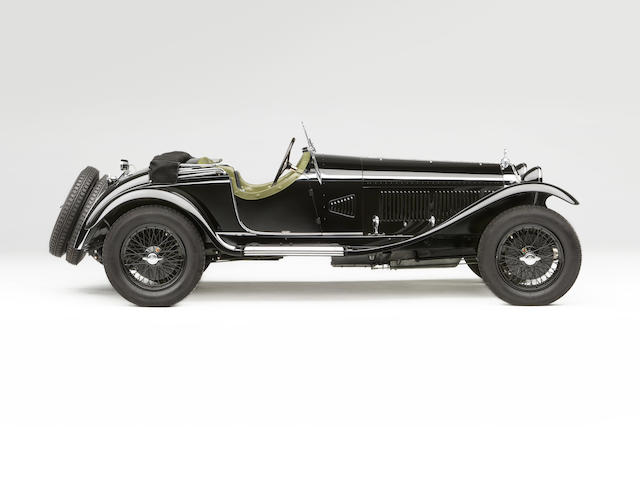
Eight million dollar Ferraris and three million dollar Porsches are fun to talk about, but everyone has one, so letÂ’s move on to some It sold for how much?! cars...
more...
Posted by: Open Blogger at
10:05 AM
| Comments (191)
Post contains 862 words, total size 7 kb.
44 queries taking 0.423 seconds, 151 records returned.
Powered by Minx 1.1.6c-pink.

